
Guides
What Should a Physical Therapist Say When a Patient Missed Their Home Exercises?
Direct answer
Ask what got in the way before judging motivation. Suggested clinician wording: “Thanks for telling me. Can you walk me through what happened?” Treat the answer as information to explore, not evidence of poor motivation. Clarify the barrier before deciding what needs attention next.
What should I clarify first?
Clarify whether the patient missed the whole routine or started some exercises.
A patient tells you they did not do the exercises. You have a few seconds before deciding how to respond.
The report alone does not tell you what got in the way.
Your next task is to understand the statement, not repeat the instructions or ask for a firmer commitment.
Why ask about barriers before motivation?
A report of missed exercises does not explain what got in the way.
Asking about barriers leaves room for the patient's explanation. This does not mean the exercise plan is unimportant. It means separating the patient's report from your interpretation.
Pinto and colleagues' review examined communication across healthcare settings, not only physical therapy. Their systematic review brought together studies using a structured search.
Listening, asking questions, and sensitivity to emotional concerns were associated with stronger therapeutic alliance, meaning the working relationship between patient and clinician. That relationship includes trust and agreement.
The evidence was limited. It supports taking that relationship seriously, but does not prove that a particular opening question changes exercise behavior.
What can I say while exploring the barrier?
Use questions that help you understand the barrier without supplying an explanation.
All clinician wording below is suggested wording, not a real conversation or a trial-tested script. Adapt it to the patient's own words.
1. Acknowledge the report
Suggested clinician wording: “Thanks for telling me. Can you walk me through what happened?”
An open question lets the patient answer in their own words. Let the patient answer before naming possible barriers. Avoid a long list that turns the conversation into a checklist.
If you need more detail, ask about the situation rather than questioning their priorities.
Suggested clinician wording: “Can you tell me more about what got in the way?”
The aim is a specific account, not a promise to try harder.
2. Clarify what the patient means
Suggested clinician wording: “Were there any exercises you started?”
Use this when the original answer is unclear. Do not keep questioning a clear report in search of a more acceptable answer.
If you review an activity record, describe only what it actually shows.
Suggested clinician wording: “Can we look at this record together?”
A missing entry and a patient reporting no exercise are different sources of information.
3. Reflect the concern without adding a motive
Suggested clinician wording: “[Summarize the concern the patient described.] Have I understood that correctly?”
Stay close to what the patient actually said. If they describe uncertainty, reflect that uncertainty. If they report symptoms, ask about them and assess them during the visit.
Do not offer standard reassurance or tell every patient to continue through pain.
4. Agree on the next question or action
Suggested clinician wording: “What would you like us to work through first?”
If the patient questions the exercises' purpose, explore that concern.
Suggested clinician wording: “What part of the plan doesn't make sense to you?”
Discuss the purpose and the patient's concerns without demanding agreement. Decisions about the exercise plan remain specific to the individual.
Before closing, summarize only actions and agreements that actually occurred.
Suggested clinician wording: “[Summarize any agreed next step.] Does that match what we discussed?”
Agreement to a discussion is not a commitment to complete every session.
What does the research tell me about missed exercises?
The research supports exploring barriers, but cannot explain why an individual missed exercises.
Ricke and colleagues' review examined home exercise adherence, meaning following an agreed exercise plan, in adults with chronic diseases. It combined a systematic review with a meta-analysis, which pools numerical results from studies.
Greater confidence, exercise history, and motivation were associated with higher adherence. So was perceived control, meaning how much control someone believes they have over doing the exercises. The authors call confidence in carrying out a behavior “self-efficacy.”
Those findings describe patterns across studies. They do not establish that low motivation caused an individual missed session. The population also extended beyond muscle, bone, and joint conditions.
Motivational interviewing is a counseling approach that explores a person's mixed feelings about change. It is not another name for asking a friendly question.
Wintle and colleagues' review examined physical therapist-delivered motivational interviewing across several rehabilitation populations. Their systematic review and meta-analysis included randomized controlled trials, which assign participants to comparison groups by chance. The review appeared online on December 31, 2024, and in a 2025 journal issue.
Adding motivational interviewing to comprehensive rehabilitation did not demonstrate an additional physical activity benefit. These trials examined physical activity, which is not interchangeable with completing a prescribed home exercise routine.
The findings also depended on what the comparison group received. They do not support a blanket claim that motivational interviewing always works or never works.
None of these reviews validates the suggested wording above. Those suggestions are not a complete motivational interviewing intervention. No script guarantees disclosure or adherence. A respectful conversation can still end with unanswered questions.
What should I write in the note?
Separate the patient's report from your observations and any next step actually agreed.
Record a reason as patient-reported when that is how you learned it.
Use this fill-in template without assuming any field has an answer:
Patient report: [What the patient reports about home exercise.]
Reported barrier: [The patient's stated reason, or that the reason remains unclear.]
Clinician observations: [What you directly observed, if relevant.]
Discussion or assessment: [What actually occurred.]
Next step or follow-up: [Any action or follow-up actually agreed, if applicable.]
This is a neutral wording template, not a complete clinical note or documentation standard. Only record actions and agreements that actually occurred.
If the reason remains unclear, say so. Do not replace an unanswered question with a judgment about the patient's character.
If a concern was recorded, use it to guide the next conversation.
Suggested clinician wording: “[Refer to the concern the patient previously reported.] What has changed since we last discussed this?”
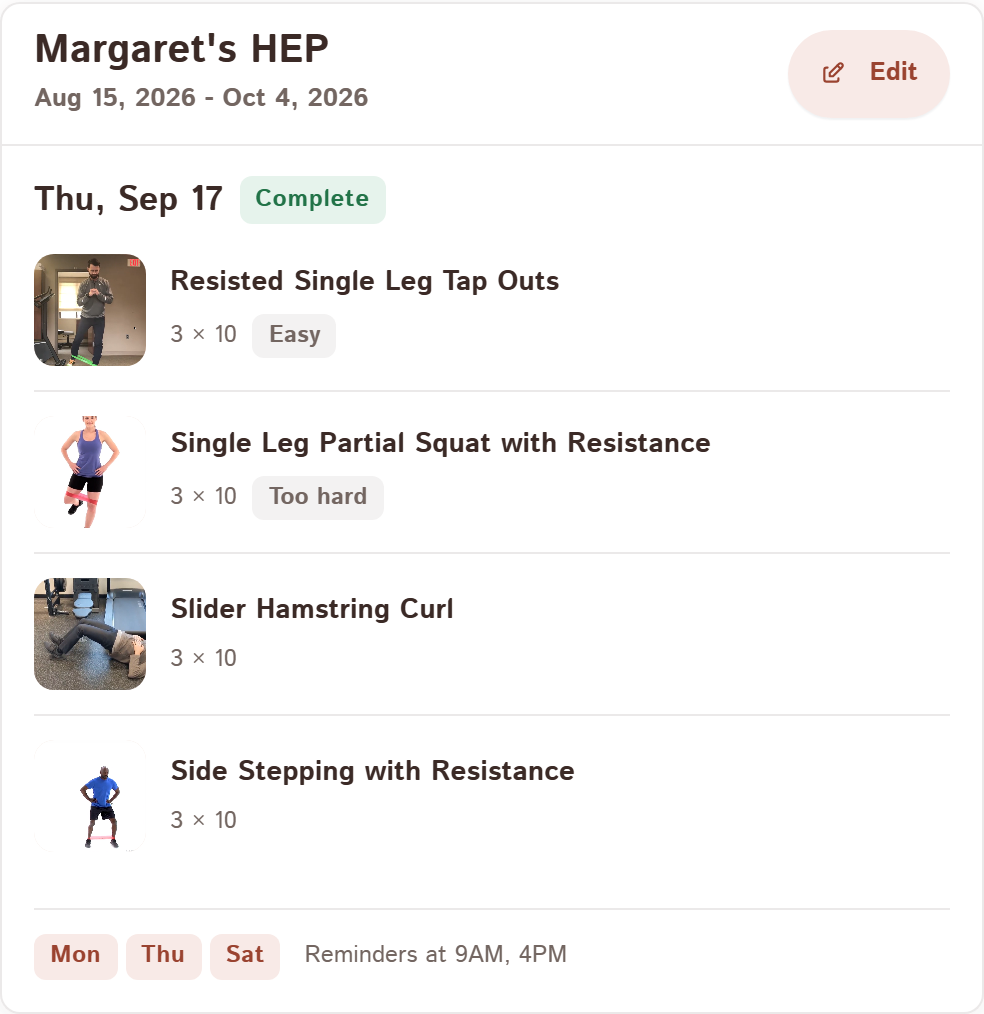
How should I use HepBuddy's activity records in this conversation?
Use the record as a starting point for questions, not an explanation for missing exercise.
HepBuddy delivers home exercise routines through the web. It also provides text reminders and activity records for clinic review. Ask what happened before interpreting an empty record as a missed session. The studies discussed here did not evaluate HepBuddy.