HepBuddy

Research

Physical Therapy Home Exercise and RTM Statistics (2026)

HepBuddy Updated

Summary

The HepBuddy 2026 RTM Adoption Report found 896 of the 77,901 private-practice physical therapists listed by CMS (1.2%) billed any RTM code to 11 or more Medicare patients in 2024 (CMS Medicare Physician & Other Practitioners, 2024 data).

This page collects numbers that physical therapy clinic owners, billers, and writers ask about. It covers two research questions. How many physical therapists bill remote therapeutic monitoring (RTM)? And what does research say about how well patients keep up their home exercises? RTM is a set of Medicare codes that pay for monitoring a patient's therapy between visits. Every statistic names who found it and when. Dated software-access terms and Medicare documentation rules appear separately below. Use the link under any fact to cite it directly.

How many physical therapists bill RTM?

  • The HepBuddy 2026 RTM Adoption Report found 896 of the 77,901 private-practice physical therapists listed by CMS (1.2%) billed any RTM code to 11 or more Medicare patients in 2024.

    Source: CMS Medicare Physician & Other Practitioners, 2024 data. Checked 11 Nov, 2026. Link to this statistic

    Limits: CMS lists a provider only if they treated 11 or more Medicare patients in the year, and lists a code only if the provider billed it to 11 or more patients. Therapists below those cutoffs are in neither count. Medicare fee-for-service claims only, so no Medicare Advantage or private insurance. Counts individual physical therapists, not clinics.

  • The HepBuddy 2026 RTM Adoption Report found 436 private-practice physical therapists billed the RTM device code 98977 to 11 or more Medicare patients in 2024.

    Source: CMS Medicare Physician & Other Practitioners, 2024 data. Checked 11 Nov, 2026. Link to this statistic

  • The HepBuddy 2026 RTM Adoption Report counted at least 28,677 RTM device services (code 98977) billed to Medicare by private-practice physical therapists in 2024, each covering a 30-day monitoring period.
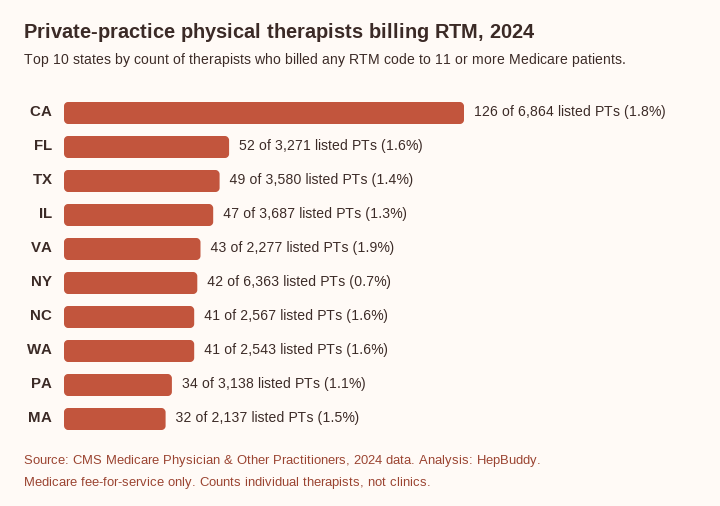
    Source: CMS Medicare Physician & Other Practitioners, 2024 data. Checked 11 Nov, 2026. Link to this statistic

Private-practice physical therapists billing RTM, top 10 states by count, 2024 CA: 126 of 6,864 (1.8%); FL: 52 of 3,271 (1.6%); TX: 49 of 3,580 (1.4%); IL: 47 of 3,687 (1.3%); VA: 43 of 2,277 (1.9%); NY: 42 of 6,363 (0.7%); NC: 41 of 2,567 (1.6%); WA: 41 of 2,543 (1.6%); PA: 34 of 3,138 (1.1%); MA: 32 of 2,137 (1.5%). Source: CMS Medicare Physician & Other Practitioners, 2024 data. Analysis: HepBuddy. Private-practice physical therapists billing RTM, 2024 Top 10 states by count of therapists who billed any RTM code to 11 or more Medicare patients. CA 126 of 6,864 listed PTs (1.8%) FL 52 of 3,271 listed PTs (1.6%) TX 49 of 3,580 listed PTs (1.4%) IL 47 of 3,687 listed PTs (1.3%) VA 43 of 2,277 listed PTs (1.9%) NY 42 of 6,363 listed PTs (0.7%) NC 41 of 2,567 listed PTs (1.6%) WA 41 of 2,543 listed PTs (1.6%) PA 34 of 3,138 listed PTs (1.1%) MA 32 of 2,137 listed PTs (1.5%) Source: CMS Medicare Physician & Other Practitioners, 2024 data. Analysis: HepBuddy. Medicare fee-for-service only. Counts individual therapists, not clinics.
Download this chart (SVG). You may reuse it with credit to HepBuddy and a link to this page.

To see what RTM pays in your ZIP code, use the RTM calculator.

What does research say about home exercise adherence?

  • A 2017 systematic review of 30 studies by Essery and colleagues reported that non-adherence to home-based physical therapy can reach 70%.

    Source: Essery et al., Disability and Rehabilitation, 2017. Checked 11 Nov, 2026. Link to this statistic

    Limits: The 70% is an upper figure the review cites from earlier research. It is not an average the review measured.

  • A 2017 systematic review by Essery and colleagues found relatively strong evidence that intention, self-motivation, self-efficacy, previous adherence to exercise-related behaviors, and social support predict adherence to home-based physical therapy.

    Source: Essery et al., Disability and Rehabilitation, 2017. Checked 11 Nov, 2026. Link to this statistic

    Limits: These are associations. They do not show that adding any one of these factors causes better adherence.

  • A 2017 meta-analysis by Nicolson and colleagues identified 3,899 studies and found only 9 randomized trials that isolated the effect of an exercise adherence intervention for adults 45 and older with chronic low back pain or hip or knee osteoarthritis.

    Source: Nicolson et al., British Journal of Sports Medicine, 2017. Checked 11 Nov, 2026. Link to this statistic

    Limits: The search ran to August 2016.

  • A 2017 meta-analysis by Nicolson and colleagues found moderate-quality evidence of a small to medium effect: booster sessions with a physical therapist helped people with hip or knee osteoarthritis stick with their exercises.

    Source: Nicolson et al., British Journal of Sports Medicine, 2017. Checked 11 Nov, 2026. Link to this statistic

    Limits: The pooled result comes from 2 trials.

  • A 2016 systematic review of 12 randomized trials by Peek and colleagues found insufficient data to endorse any adherence aid in clinical practice, including activity monitors, written exercise instructions, booster sessions, and goal setting.

    Source: Peek et al., Physiotherapy, 2016. Checked 11 Nov, 2026. Link to this statistic

    Limits: The search ran to November 2014.

  • A 2024 study by Roberts and colleagues found that people recently discharged from chronic low back pain treatment who reported more social support did more exercise sessions over the next 6 months.

    Source: Roberts et al., Journal of Back and Musculoskeletal Rehabilitation, 2024. Checked 11 Nov, 2026. Link to this statistic

    Limits: A secondary analysis of data from a small pilot trial, the same trial as the Fritsch pilot below. Support was the participant's own rating at the start. Exercise was self-reported in weekly online diaries. It shows an association, not cause.

  • A 2024 pilot trial by Fritsch and colleagues, with 30 adults with chronic low back pain in three groups, found 85% of the group given health coaching plus an exercise buddy said the buddy helped them become more active.

    Source: Fritsch et al., Musculoskeletal Science and Practice, 2024. Checked 11 Nov, 2026. Link to this statistic

    Limits: Self-reported opinion from one group in a 30-person feasibility pilot. The buddy was a person to exercise with, not a text-message supporter. Follow-up data collection fell short, so the trial could not show whether activity changed.

What software-access deadlines should clinics check?

These are documented vendor terms, not clinical statistics. Confirm your account's current agreement before relying on a deadline.

  • Physitrack's cancellation instructions, checked in November 2026, say assigned exercise programs end 7 days after a subscription ends.

    Source: Physitrack, Cancel (and restart) subscription, checked November 2026. Checked 12 Nov, 2026. Link to this statistic

    Limits: A documented vendor policy, not a clinical research finding or an independent product test. Patients can then no longer provide feedback. Cancellation does not delete account data. Confirm the current terms and dates for your account; PT Direct subscriptions are organization-managed. Do not apply this timing to another vendor.

Which Medicare documentation windows need separate review?

These are documentation rules, not clinical statistics. CMS means the Centers for Medicare & Medicaid Services. Read each limit with its number.

  • CMS's therapy manual, checked in November 2026, requires certification within 30 days of initial therapy treatment under a significantly modified plan.

    Source: CMS Medicare Benefit Policy Manual, Chapter 15, section 220.1.2(C), checked November 2026. Checked 18 Nov, 2026. Link to this statistic

    Limits: A Medicare outpatient therapy documentation rule, not a clinical statistic. The therapist must not significantly alter a certified plan without documented written or verbal approval from the physician or eligible practitioner. This certification window does not replace that approval or become the deadline for every ordinary recertification. The article applies the rule to Original Medicare Part B physical therapy in private practice.

  • CMS's therapy manual, checked in November 2026, describes acceptance without justification for certifications up to 30 days after they are due.

    Source: CMS Medicare Benefit Policy Manual, Chapter 15, section 220.1.3(D), checked November 2026. Checked 18 Nov, 2026. Link to this statistic

    Limits: This manual statement is not a universal grace period or a promise of payment. Under 42 CFR 424.11(d)(3), delayed certification and recertification statements need a legitimate reason for delay and an explanation. The manual's remaining delayed-documentation guidance and the facts of the case still matter. Resolve uncertain cases with the Medicare contractor or a qualified billing adviser.

Our Medicare PT recertification worklist separates significant plan changes from late signatures and other open tasks.

How we got the RTM numbers

HepBuddy counted the RTM numbers from two public files that CMS, the federal Medicare agency, publishes every year. Both are part of the "Medicare Physician & Other Practitioners" data. One lists each provider. The other lists each code each provider billed. The newest year CMS has published is 2024.

  • Who we counted. Every provider CMS lists as a "Physical Therapist in Private Practice." CMS lists only providers who treated 11 or more Medicare patients in the year. Each one is an individual therapist, not a clinic.
  • What counts as billing RTM. Billing any of the 2024 RTM codes: 98975, 98976, 98977, 98978, 98980, or 98981.
  • What the numbers miss. CMS also leaves out any code a provider billed to fewer than 11 Medicare patients. So therapists who billed RTM to only a few patients are not counted, and the true number of RTM billers is higher.
  • Which patients. Traditional Medicare only. The files do not include Medicare Advantage or private insurance.
  • New codes. For 2026, CMS began paying for new RTM codes. Two apply to muscle, bone, and joint care: 98985, for 2 to 15 days of monitoring, and 98979, for the first 10 minutes of management. The 2024 data comes before them.

We will update these numbers when CMS publishes a new year.

How to cite these numbers

Name the source and the year, and link to the statistic you used. For the RTM numbers, write "HepBuddy 2026 RTM Adoption Report, based on CMS 2024 data." For the research numbers, cite the original study named under each statistic.