
RTM billing basics
RTM Codes in Plain English: 98975, 98977, 98985, 98979, 98980 and 98981
Summary
Remote therapeutic monitoring (RTM) has six codes that outpatient physical therapy clinics use for muscle, bone and joint care. They fall into three groups: setup, the monitoring device, and your management time. This page covers Original Medicare in 2026.
- Setup (98975). Once per episode of care.
- The monitoring device (98985 or 98977). You pick by how many days of data came in during a 30-day period.
- Your management time (98979, 98980, 98981). You pick by the minutes you spent in a calendar month.
I put the six codes in the order you would think about them.
The six codes at a glance
| Code | What it covers | What decides it | Needs a live conversation? |
|---|---|---|---|
| 98975 | Setup and patient education on the equipment | Once per episode of care | No |
| 98985 | Device supply, 2 to 15 days of data | Days with data in a 30-day period | No |
| 98977 | Device supply, 16 to 30 days of data | Days with data in a 30-day period | No |
| 98979 | Management, first 10 minutes | 10 to 19 minutes in a calendar month | Yes |
| 98980 | Management, first 20 minutes | 20 or more minutes in a calendar month | Yes |
| 98981 | Management, each additional 20 minutes | Each further full 20 minutes in a calendar month | Yes, the same month's conversation as 98980 |
The code descriptions come from the Centers for Medicare & Medicaid Services (CMS) 2026 therapy code list update. I checked that document on November 13, 2026.
98975: setup and patient education
This code covers the first setup of the monitoring equipment or software and teaching the patient to use it. You report it once per episode of care. It is not a monthly code.
For Medicare in 2026, the monitoring requirement tied to 98975 is two days in a 30-day period. Older worksheets still say 16. I wrote up where that two-day figure comes from.
Two days of data do not show that setup and education happened. Keep a note of what you taught and when.
98985 and 98977: the monitoring device
These two are alternatives for the same 30-day period. You bill one, never both.
- 98985 is for 2 to 15 days with data in the 30-day period.
- 98977 is for 16 to 30 days with data in the 30-day period.
- Zero or one day fits neither code.
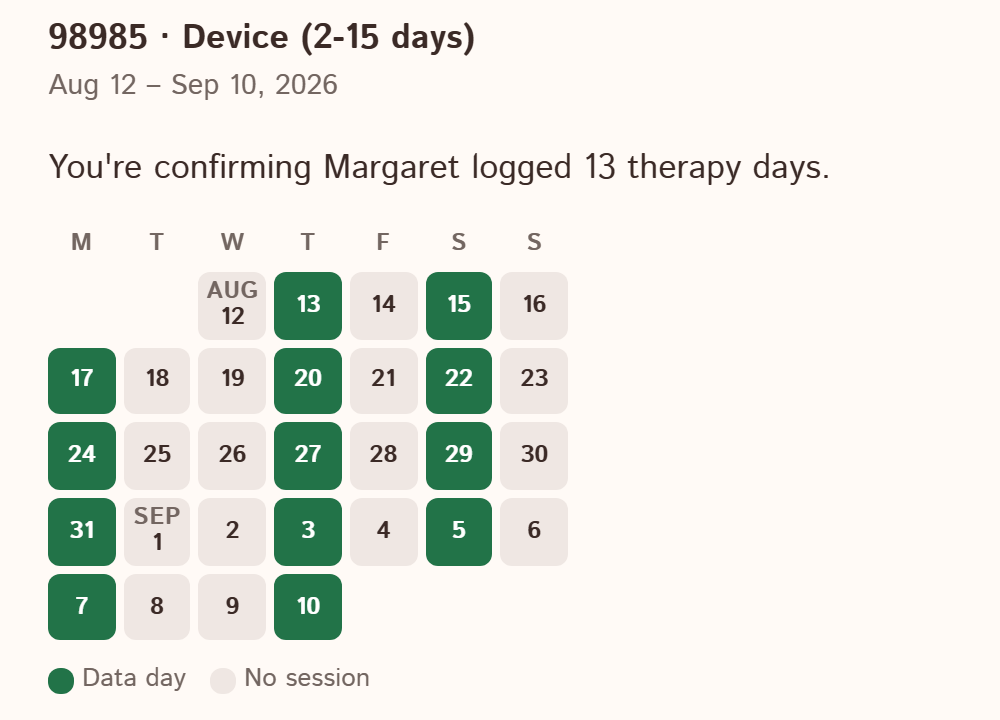
What a 30-day period looks like in HepBuddy. Each green day is a data day. This patient logged 13, so the period fits 98985.
Medicare pays the same amount for 98985 and 98977:
- Crossing 16 days changes which code you bill. It does not change the payment.
- A patient with three data days can be billed under 98985 at the same rate as a patient with thirty days under 98977.
- I would not treat 16 days as a goal for billing reasons. Whether a patient does more exercise is a clinical question.
Other rules that apply to these codes:
- Neither one needs a live conversation with the patient.
- The software has to meet the FDA's definition of a medical device. HepBuddy's position is that it does, under FDA enforcement discretion. It is not FDA-cleared or approved. Our intended-use statement explains.
- A physical therapist delivers RTM under a therapy plan of care and uses the GP modifier. CMS names GO for occupational therapy and GN for speech-language pathology.
- RTM needs documented patient consent before it starts, and a clinician has to review the data. HepBuddy records the consent at enrollment. The review is yours.
- Only one practitioner can bill RTM for a patient in a 30-day period. If another practice might already be monitoring your patient, read this check first.
98979, 98980 and 98981: your management time
Management codes are about your time, not the patient's exercise. The clock is the calendar month, not the 30-day device period. My guide to the two clocks shows how they overlap.
- 98979 covers the first 10 minutes. You reach it at 10 to 19 minutes in the month.
- 98980 covers the first 20 minutes. You reach it at 20 minutes or more.
- 98981 covers each additional full 20 minutes beyond the first 20. A partial block does not count, so 85 minutes is 80 billable minutes.
- 98979 and 98980 are alternatives. You do not stack them, and 98981 adds to 98980 only.
All three need at least one live, back-and-forth conversation during the month. CMS writes it as "at least 1 real-time interactive communication with the patient or caregiver during the calendar month." The conversation counts toward your minutes. It does not have to fill all of them.
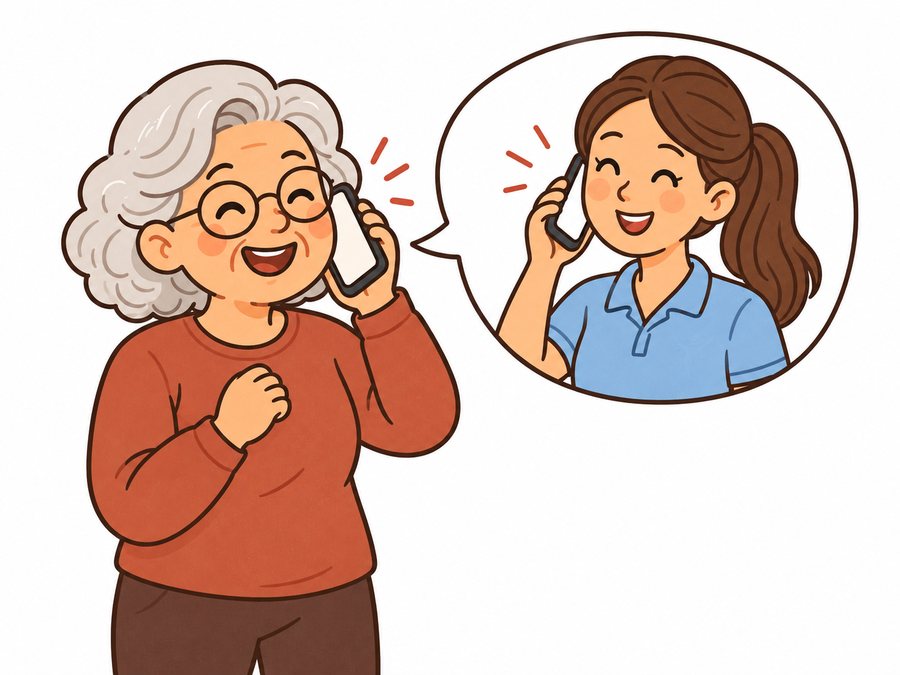
What counts as live:
- A phone or video call: yes.
- A voicemail: no.
- Automatic texts: no. The texts HepBuddy sends to a patient's buddy never count toward this requirement.
CMS's wording says "patient or caregiver." Whether a live call with someone in the patient's family satisfies it is a question for your billing and compliance team. HepBuddy does not decide it for you.
The time has to be clinician time on RTM work, such as:
- reviewing data
- adjusting the program
- talking with the patient
- coordinating with the referring physician
If a physical therapist assistant does part of a management service, the CQ modifier rules can apply. Ask your biller. My guide to minutes and live contact goes through what the record needs.
Contact should be clinically warranted. Do not schedule a call only to reach a code.
What Medicare pays where you practice
Enter your practice ZIP code to see the 2026 Medicare amounts for each code in your area. Rates change by location.
See what RTM pays in your ZIP code.
Rates change based on your location. Check your exact monthly reimbursement based on your caseload and clinical time.
Monitoring · 98977 / 98985—
Management · 98980—
—
every 30 days
Keep in mind:
- These are Medicare allowed amounts, not a promise of payment. Actual payment depends on coinsurance and other adjustments.
- Your clinic decides whether each service qualifies.
- Medicare Advantage and private plans set their own rules, so check each payer before you enroll a patient.
The RTM calculator page has the same tool.
How HepBuddy fits
HepBuddy supports RTM device-code documentation. The clinic independently determines eligibility and medical necessity.
Here is what that means day to day:
- HepBuddy logs a data day for every day your patient logs any exercise, and it tracks the 30-day window.
- It keeps the time log. You log each piece of work, and it is marked PT or PTA.
- It tells you when a code is ready to review.
- You approve the charge and enter it in your EMR. HepBuddy has no EMR connection, and it never contacts insurers or submits a claim.
- Your own team does the check-ins and the live calls. HepBuddy does not outsource them.
HepBuddy does not choose which patients qualify, and it does not decide what you bill.
Try it with one patient
HepBuddy is $125 a month per therapist with unlimited patients. Your first patient needs no card. If you add a card, your 42-day trial starts. No call is required.
This page is how I read the CMS documents. It is not billing or legal advice.