
Competitor comparisons
Moving off PT Wired? What the sites say and what HepBuddy does
Summary
PT Wired's website now says PT Wired is Prompt Engage, and that visitors will be redirected to Prompt Health. If your clinic uses PT Wired for home exercise programs, you are going to move to something. Below I quote what PT Wired and Prompt say on their own sites, list the questions I would ask, and explain HepBuddy as one option, including what it does not do.
What the PT Wired site says today
I loaded ptwired.com on November 13, 2026. It says:
PT Wired is now Prompt Engage. In one month you will be automatically redirected to Prompt Health when you visit this site. You can get ahead of the move by updating your bookmarks now.
Prompt's page for Prompt Engage (prompthealth.com/products/engage) is labeled "Formerly PT Wired." I read it the same day. It says:
- "Build custom Home Exercise Plans (HEPs) from 6,000+ video exercises"
- "Automatically track Remote Therapeutic Monitoring (RTM) activities and bill for care between visits."
- "Patients download your clinic's app, with your logo, colors, and name."
What the public pages do not tell me:
- When the redirect happens. The PT Wired page gives no date, so "one month" is measured from a day I cannot see.
- What happens to your existing patient programs and records.
- What you will pay.
- Whether Prompt Engage is sold on its own or only with Prompt's EMR.
I am not going to guess at those.
Questions to ask before you pick anything
Ask these of Prompt, and of any tool you look at:
- What happens to my patients' current programs and links on the day the redirect starts?
- Can I export my exercise templates and my records? For how long after I leave?
- What will I pay per month after the move?
- Do my patients have to download something new?
- If I bill RTM: what happens to a patient who is in the middle of a monitoring period?
My guide on records versus patient access covers the handover in more detail.
What HepBuddy is
HepBuddy is home exercise software for outpatient physical therapy clinics. It has no app for patients. Here is what your patient sees:
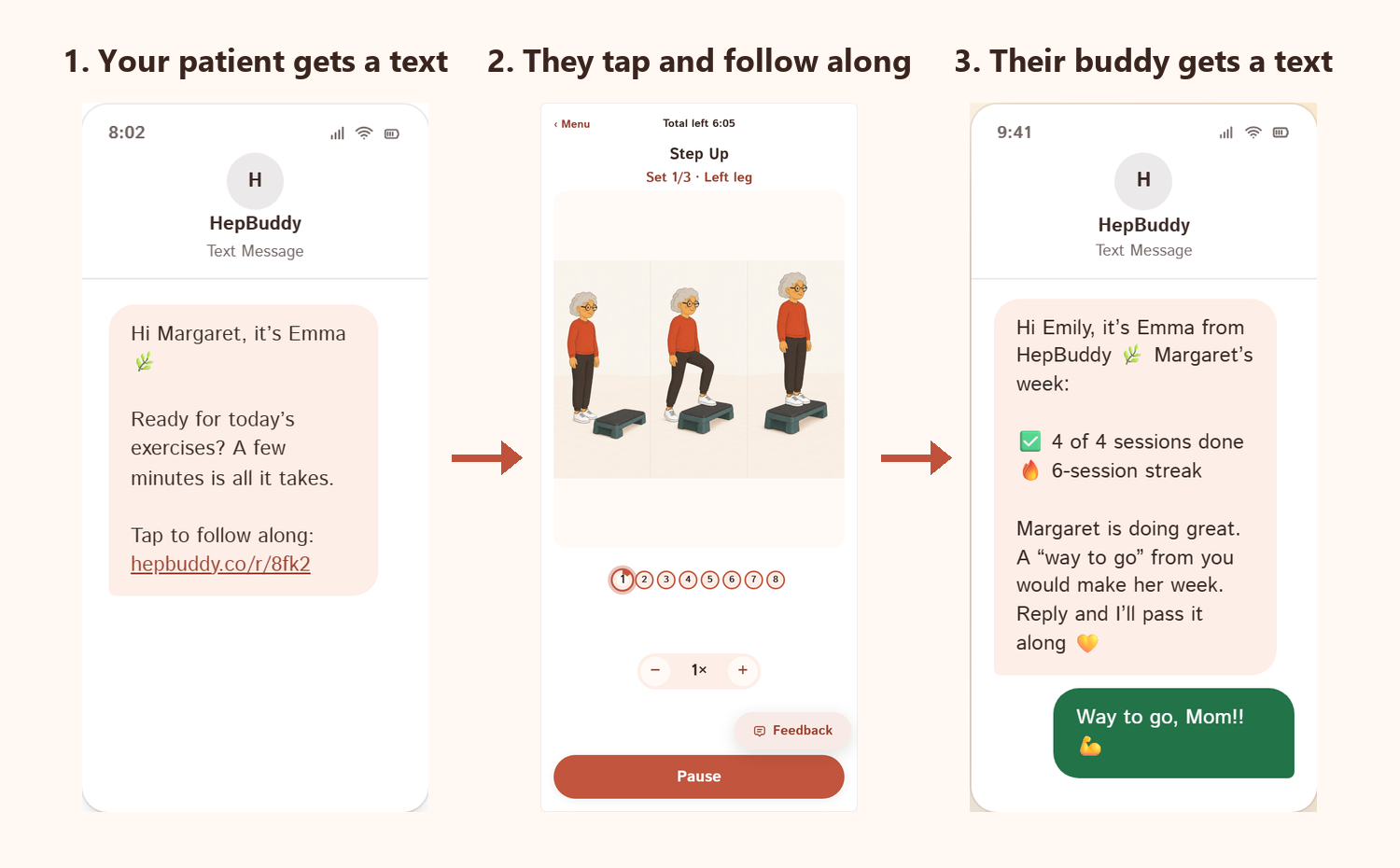
- Patients get a text. On an exercise day your patient gets a text with a link. They tap it and follow a guided session. There is nothing to download, and no account or password.
- Sets are logged for you. The session logs sets automatically, and your patient reports effort and pain on each exercise.
- The patient picks a buddy. Your patient chooses someone who wants them to get better, like a spouse, an adult child or a friend. That person gets a text when your patient finishes a session. The buddy sees exercise names, days done and the streak, and only after the patient signs an authorization.
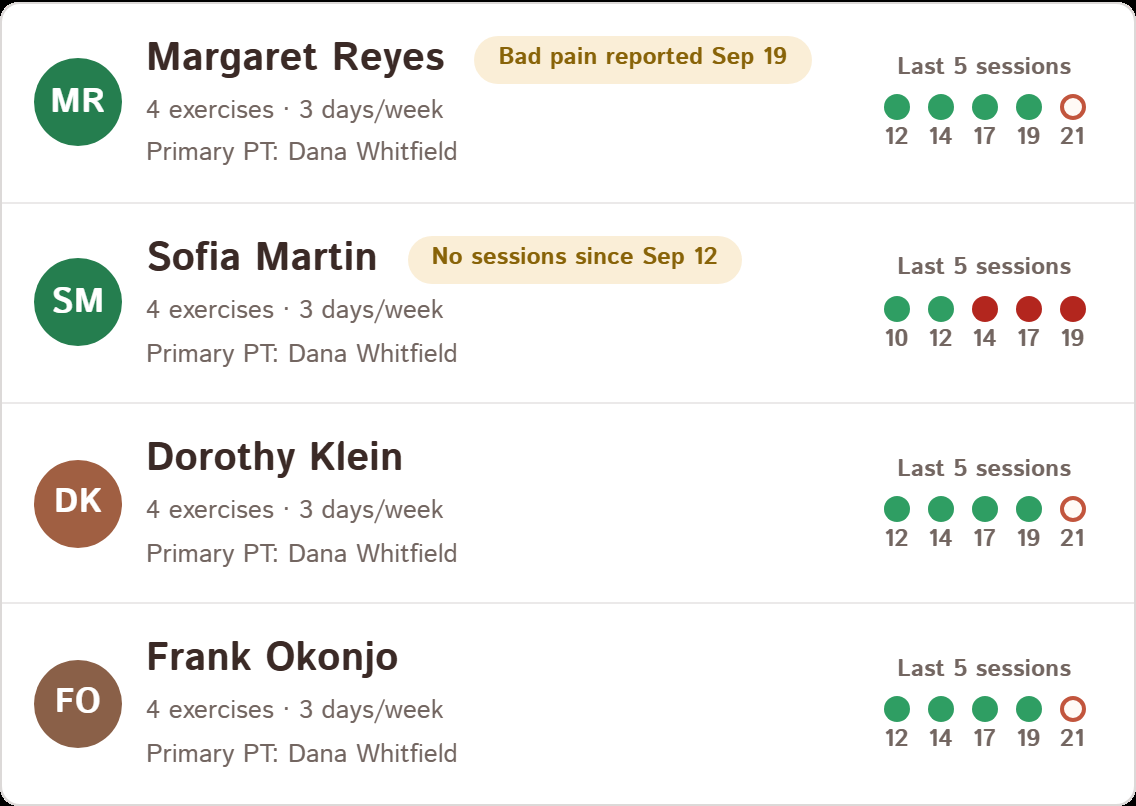
- Your board shows who needs you. You see which patients to check in with first, and the pain and effort ratings that tell you what to progress or scale back.
- RTM support. HepBuddy supports RTM device-code documentation. It counts data days, keeps the time log you enter, and tells you when a code is ready to review. The clinic independently determines eligibility and medical necessity. You approve the charge and enter it in your EMR. HepBuddy never contacts insurers. My RTM codes guide explains each code.
- Flat price. $125 a month per therapist, unlimited patients, no setup fee, email support.
And here is what you see. Patients who need a check-in show up first:
What HepBuddy does not do
- It has no EMR connection. Nothing goes into your EMR automatically.
- It has no importer. I have not built a way to bring in PT Wired programs or patients, so you rebuild them.
- It has no clinic-branded app. Patients get a text link instead.
- Its exercise library has 195 exercises. You can browse them or film your own.
How switching works
- Sign up online. No call is required.
- Rebuild your programs from the 195 exercises, or film your own.
- Add one patient. Your first patient needs no card.
- Add a card when you are ready. That starts a 42-day trial, billed at $125 per therapist per month only if you do not cancel before it ends.
- Move other patients when you are comfortable. You do not have to move everyone at once.
If a patient is partway through an RTM period in your old tool, ask your biller when to move them. Device periods run 30 days and management runs by calendar month, which I explain in this guide.
Try one patient
I wrote this page on November 13, 2026, and the PT Wired and Prompt pages may change. Check them directly before you decide. HepBuddy is not affiliated with PT Wired or Prompt.